
Home » Attic Ventilation & Ice Dam Prevention Cost Calculator
Why Attic Ventilation and Ice Dam Prevention Are Critical in Omaha, NE
Every winter across Eastern Nebraska, homeowners in Omaha, Bellevue, Elkhorn, and Papillion face the destructive consequences of poor roof thermodynamics. When heavy snowfall accumulates on your roof shingles and exterior temperatures plunge into single digits, an under-ventilated or poorly insulated attic acts like an unintended thermal engine.
Attic Ventilation & Ice Dam Prevention Cost Calculator
Official Omaha Attic & Ice Dam Estimate
Estimated Ventilation & Dam Prevention Investment
$4,643
Expected Project Range: $4,179 – $5,200
Unit Cost:
$2.58 / sq.ft
Per Square (100 sq.ft):
$258 / sq
Cost Distribution:
Materials (42%)
Labor (34%)
Air Sealing (18%)
Diagnostics (6%)
1. Premium Ventilation Hardware & Thermal Barriers
High-flow ridge vents, rafter baffles, heat trace cables & intake grilles
$1,950.06
2. Attic Air Sealing & Soffit Clearing Prep
Polyurethane foam expansion on top plates, wire penetrations & insulation clearance
$835.74
3. Master Certified Attic & Electrical Labor
Roof deck cutting, sealed vent fastening, dedicated GFCI circuit wiring & calibration
$1,578.62
4. Thermal Imaging Diagnostic & City Compliance
Pre- and post-install infrared camera heat-loss audit and building code certification
$278.58
Need a Free Infrared Attic & Heat-Loss Inspection?
JB Roofing provides complete drone & thermal camera inspections across Omaha, Bellevue, Papillion & Elkhorn.
How to Calculate Attic Ventilation Cost Step by Step
Understanding how to calculate attic ventilation cost step by step gives homeowners full transparency into how professional contractors assemble an actionable estimate. The formula combines physical square footage, system unit rates, architectural complexity multipliers, Douglas County climate constants, and fixed diagnostic auditing fees.
Step 1: Determine Your Attic Footprint in Square Feet
Measure or look up the conditioned living footprint directly beneath your roofline. In roofing terminology, 100 square feet equals 1 “Roofing Square.” Example: A two-story suburban home with a ground floor footprint of 900 sq. ft. has a 900 sq. ft. attic footprint. A sprawling one-story ranch home measuring 30 ft. by 60 ft. has an attic footprint of 1,800 sq. ft. (18 roofing squares).Step 2: Select Your Prevention & Ventilation System
Select the engineering system that addresses your home’s thermodynamic vulnerability:- Balanced Ridge & Soffit Vents: $1.85 per sq. ft.
- Solar Attic Fan & Baffles: $2.65 per sq. ft.
- Self-Regulating Heat Cables: $3.45 per sq. ft.
- R-49 Blown Shield & Thermal Air Seal: $4.20 per sq. ft.
Step 3: Assess Your Ice Dam Severity and Eave Complexity
Evaluate the historical severity of ice dam formation, pitch steepness, and valley concentrations around your home:- Standard Eaves (Low Risk) [1.00x]: Straight gables, unobstructed gutters, minimal historical ice damming, roof pitches between 4:12 and 6:12.
- Moderate Valleys (Mid Risk) [1.18x]: Roof designs with 2 to 4 roof intersections, dormers, partial shaded northern exposures, historical gutter icicles.
- Severe Ice Dams (High Risk) [1.30x]: Deep architectural valleys converging over entryways, multi-tier rooflines, documented past interior water damage, roof pitches above 8:12 requiring OSHA tie-off rigging and scaffold work.
Step 4: Apply the Regional Douglas County Climate Multiplier
Every building science project in the Omaha metropolitan area is subject to a 1.04x regional factor. This covers Nebraska winter design temperature standards (-10°F design limits), high wind resistance specs (up to 90 MPH gusts), and strict local building inspections.Step 5: Add the Baseline Diagnostic & Thermal Imaging Fee
All comprehensive mitigation installations begin with an infrared thermal imaging audit and attic pressure envelope test, established at a fixed $195.00 base fee.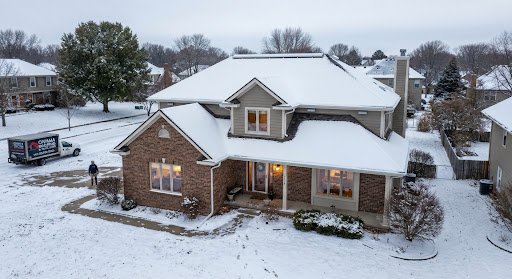
Protect Your Home from Winter Ice Dams Today
Do not wait for the next sub-zero Nebraska blizzard to find out if your roof can handle the freeze-thaw cycle. A minor ice dam can cause thousands of dollars in hidden framing rot, wet insulation, and ruined interior ceilings.
Use our attic ventilation and ice dam prevention cost calculator omaha to gauge your project parameters, then contact the certified building envelope specialists at JB Roofing for an on-site thermal imaging evaluation:
Frequently Asked Questions
Clear, honest answers about our roofing processes, warranties, and service coverage.
How do I know if my Omaha home needs more attic ventilation or more insulation?
Both systems work in tandem, but they display distinct warning signs:
- Ventilation Deficiency: If your attic feels like a sauna during humid July afternoons, or if you notice dark mold, damp rafters, and frost accumulating on roof nail tips during January, your intake and exhaust airflow is inadequate.
- Insulation Deficiency: If snow melts quickly off your roof deck while staying thick on your neighbor’s roof, or if you can see the top edges of your ceiling joists in the attic, your insulation level is below current code standards. Current Douglas County energy codes recommend an R-49 rating (approx. 16–18.5 inches of settled blown fiberglass or cellulose).
What is the average cost to fix ice dams on a roof in Omaha, NE?
Emergency steaming to remove active ice dams averages $1,200 to $2,500 ($400–$800/hour). However, permanently preventing future ice dams through an engineered combination of balanced ridge/soffit vents, thermal bypass air sealing, and rafter baffles averages $3,658 to $5,200 for a typical 1,800 sq. ft. home.
How much do self-regulating heat cables cost per foot installed?
Commercial-grade self-regulating roof de-icing heat cable installed by a certified roofing crew costs between $16 and $32 per linear foot, including dedicated heavy-gauge mounting clips and waterproof junction boxes. A typical 120-linear-foot installation across vulnerable eaves, gutters, and downspouts ranges between $1,920 and $3,840. Always avoid cheap big-box store constant-wattage heat tape, which creates electrical fire hazards and lacks automatic thermal self-regulation.
What is the attic insulation R-49 upgrade cost in Omaha?
Upgrading an under-insulated attic from R-19 (approx. 6 inches) to the Nebraska Energy Code standard of R-49 (approx. 18.5 inches of blown-in fiberglass or cellulose) costs between $1.60 and $2.80 per square foot. For an 1,800 sq. ft. home, expect to invest $2,880 to $5,040, which includes comprehensive attic floor air sealing (sealing top plates, wire penetrations, and can lights with expanding foam) and installing rigid rafter intake baffles at every eave bay.
Can I install heat cables directly inside my gutters and downspouts?
Yes. In fact, running self-regulating heat cable through your gutters and down into the downspouts is essential for cold-climate ice prevention. It creates a continuous heated meltwater channel that allows melted runoff from roof valley cables to drain completely to the ground without re-freezing into solid ice plugs inside your aluminum downspouts.